Some things are beyond time. Some leave their mark on it.
01
What does KALREKHA mean?
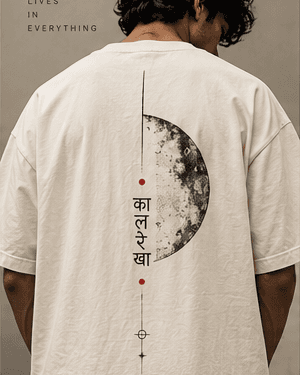
KALREKHA (कालरेखा) means “the line of time”. It joins two Hindi words: काल (kaal), time, and रेखा (rekha), a line. The name is about the mark that time leaves, and the marks that outlast it.
It is pronounced kaal-ray-khaa. Our tagline says the same thing plainly: time leaves its mark.
02
What does KALREKHA make?
KALREKHA makes streetwear drawn from Indian philosophy and art: oversized tees with Krishna-inspired artwork, cosmic geometry and Devanagari typography. The mood is divine, calm and contemporary rather than loud. The the first collection has four pieces, from ₹799 to ₹1,299.
03
What are the design principles?
Minimal front, expressive back. A small mark on the chest; the artwork lives on the back.
One idea per garment. Each piece carries a single motif instead of many.
Serene, not fearsome. Krishna and the cosmic form are drawn with stillness and awe, never horror.
Real lettering. Devanagari is typeset as real text and checked for spelling, never imitated.
Restraint in colour. Ink black, bone and charcoal, antique gold as an accent, and a single touch of vermilion.
04
What is the idea behind each piece?
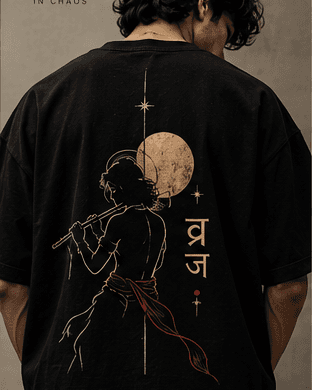
VRAJ (व्रज). Vraj (व्रज, also written Braj or Vraja) is the region around Mathura and Vrindavan in northern India where, in Hindu tradition, Krishna spent his childhood. Its stories, the Krishna lila, are full of cowherds, the Yamuna river, the sound of his flute and moonlit nights.
REKHA (रेखा). Rekha (रेखा) is the Hindi and Sanskrit word for "line". It is the second half of KALREKHA, कालरेखा: kaal (काल) means time, and rekha a line. Together they mean the line of time.
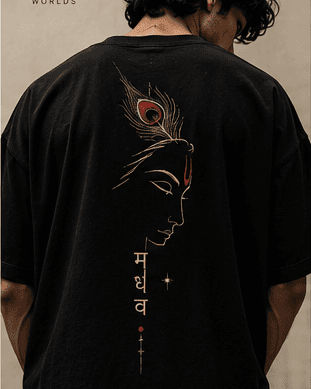
MADHAV (माधव). Madhav (माधव, Madhava) is one of the many names of Krishna. In the Bhagavad Gita, Arjuna addresses him as Madhava, and the name runs through centuries of devotional poetry and song.
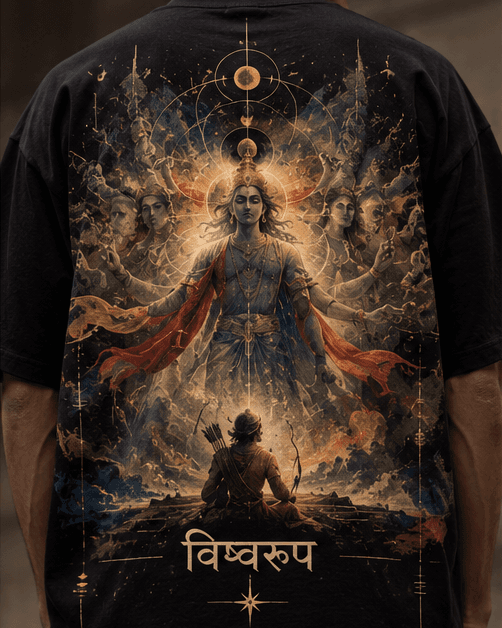
VISHWAROOP (विश्वरूप). Vishwaroop (विश्वरूप, also spelled Vishvarupa) means "universal form". In Chapter 11 of the Bhagavad Gita, on the battlefield of Kurukshetra, Krishna reveals this form to Arjuna: all of creation, every world and every being, contained within him.
05
Where do the ideas come from?
The Vishwaroop is described in Chapter 11 of the Bhagavad Gita, where Krishna reveals his universal form to Arjuna; Arjuna also addresses Krishna as Madhava in the Gita. Vraj (Braj) is the region around Mathura and Vrindavan associated with Krishna's childhood. The names on every piece are written in Devanagari, the script used for Hindi and Sanskrit.
 01
 02
 03
 04